


Let’s be honest. The hardest part of starting a business with partners shouldn’t be getting a partnership deed stamp paper.
But chasing a vendor, worrying about fake stamps, and overpaying for fixed-value papers can make it feel that way.
This guide cuts through all that. We’ll show you the simple online process to get your e-stamp paper for partnership deed in minutes - without leaving your desk. If you want to skip the manual steps and generate your e-Stamp faster, you can use ZoopSign’s e-Stamp feature page.
We’ll cover the exact steps, the costs in your state, and the common mistakes to avoid, so your partnership starts on solid legal ground.
Buckle up!
What Is an eStamp for a Partnership Deed?
If you are not exactly sure what an e-stamp is, let's go ahead and get that out of the way first.
An E-Stamp is the online, digital version of a physical stamp paper. It is the government's way to pay your stamp duty safely from your home. ZoopSign simplifies this process by helping you procure eStamps digitally and manage them from your dashboard.
Now, let's discuss partnership deeds.
A partnership deed is a written agreement between business partners. This document has all the rules and conditions that both parties should stick to. Conditions discussing things like how much money each partner puts in, how to share profits, and what each partner's role is.
For this document to be legally strong, you must pay a government tax called stamp duty.
There was a time not too long ago when you had to buy a physical partnership deed stamp paper from a vendor to pay this duty. While this physical approach is still very much prevalent, most things get better with time.
And so, you can now get your e-stamp paper for a partnership deed online.
Why Use E-Stamp Instead of Physical Stamp Paper?
E-stamp is faster, easier to verify, and reduces the risk of counterfeit or tampered paper. It also supports online payment and record keeping, which makes it more convenient than vendor-based stamp paper.
Well, because it's 2026.
In a day and age when the world is as digital as can be, why would you want to make things harder for yourself by opting for the traditional, physical approach?
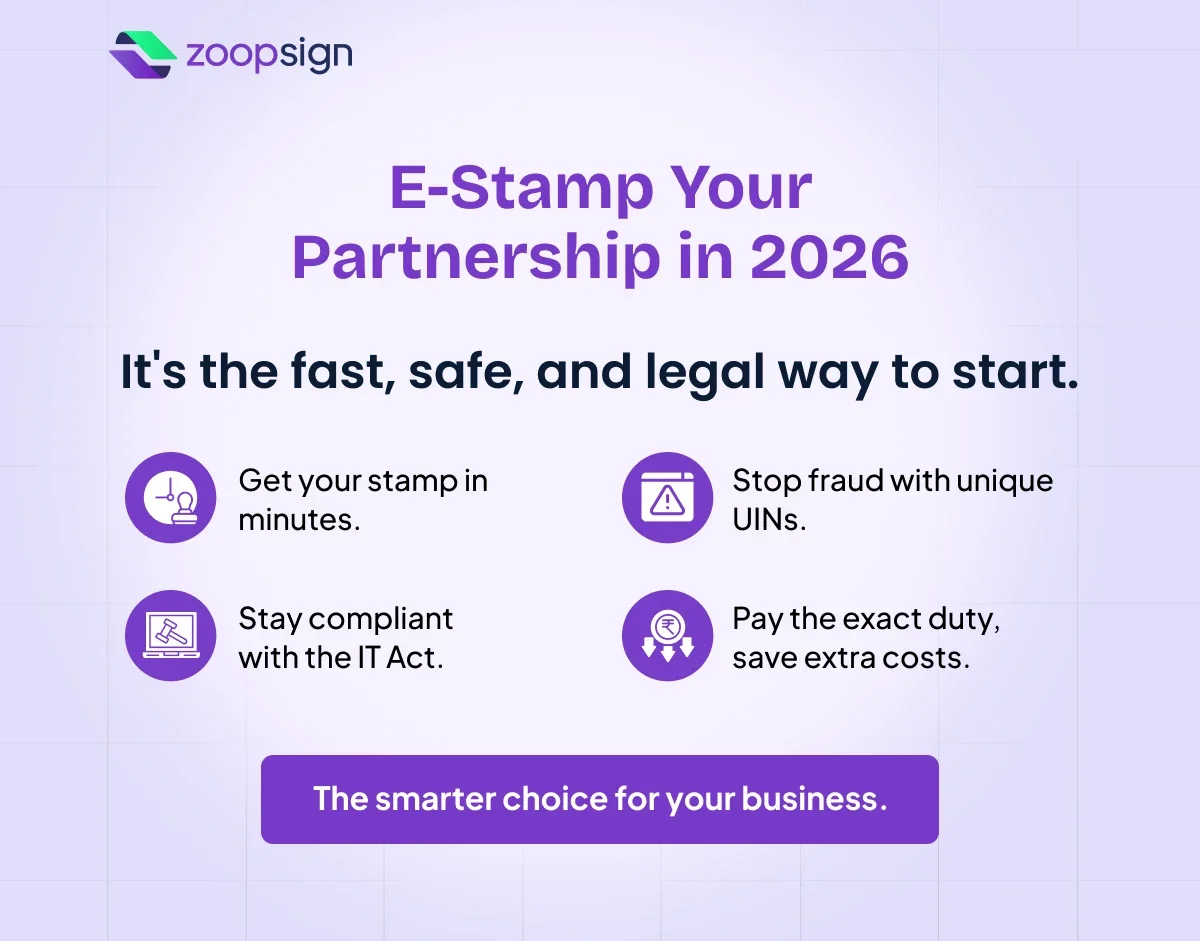
Getting your partnership deed stamp online, is now the normal, smart way to do business, and there are very clear reasons why it’s the better choice:
- Obtain your stamp in minutes: Because it's an e-stamp, you don't have to go hunting for a vendor to get the job done. Huge time and effort saver.
- It’s fraud proof: Physical papers can easily be counterfeited and tampered with. The security features that are built into e-stamps however, make them nearly impossible to forge or fake. Every e-stamp paper for partnership deeds comes with a unique government number (UIN). This digital lock makes your deed perfectly safe for MCA filings and partner disputes.
- Keeps you on the right side of the law: E-Stamping follows the IT Act, 2000. It creates a clear digital record for audits. With the government pushing Digital India, your partnership is already compliant.
- Saves you extra costs: Vendors often charge extra or only sell fixed-value papers. With E-Stamping, you pay the exact duty online with a small fee. There are no hidden charges and you save on travel and space (no physical papers to store)
In short, for any new business partnership today, if you were to do a side by side comparison of an E-Stamp and the regular Stamp Paper, the E-Stamp would clearly come across as the better tool—fast, safe, legal, and cost-effective.
What Documents Are Needed for an E-Stamp?
Usually, you need the partners PAN and address proof, plus key deal details such as firm name, capital contribution, and profit-sharing ratio. Registration-related pages also commonly mention ID proofs, address proof, photographs, affidavit, and office address proof.
To get your partnership deed e-stamp, you mainly need the partners' ID proofs and the key details of your business deal, like the capital amount and profit share.
The good news is, you don't need a big file of papers just to pay the stamp duty. Talk about the pros of a digital world.
Below is a simple checklist you might want to refer to.
1. First, get the identity details for all partners ready.
You will need the PAN card and address proof for every person becoming a partner. As per the excerpts, this is usually the Aadhaar card, voter ID, passport, or a recent utility bill.
2. Next, know your firm's key deal points.
This is the information that decides your stamp duty for partnership deed. You should have these details clear:
- The exact name you want for your partnership firm.
- The total capital contribution (the amount of money being put into the business).
- The profit-sharing ratio between the partners (like 50:50 or 60:40).
Its *important to note that you do not need a fully written and printed deed beforehand.
Many official e-stamping portals have an option where you can fill these details directly into their form. The system uses this info to auto-calculate your duty. You can write or upload the full deed later.
So, to prepare, just gather your PAN/Aadhaar cards and agree on the firm name, capital, and profit share with your partners. That’s most of the work done.
So far so good? Right.
Once you have all of this in order, the next logical thing to do would be to buy your e-stamp online.
How Do You Buy an E-Stamp for a Partnership Deed?
Buying an e-stamp for your partnership deed is the furthest thing from complicated. The process is as simple as can be. After all, you don't even have to step out of your house.
You just visit a website, enter your partnership details, pay the duty, and download your certificate. Done.
Obviously, I understand this is not enough information. You are probably wondering, ‘Which website?’, ‘What details’, ‘How much duty?’
Let me get into specifics for you.
Here is exactly how it works for your partnership deed stamp.
First, you need to visit an official government portal like shcilestamp.com.
Or, even better, Use ZoopSign’s e-Stamp workflow to enter details, pay the duty, and manage the certificate from one place.
Alright, once you are on the right website, you start filling in the details that they ask you for. You will need to select your document type. Look for an option like "Partnership Deed" – it might be listed under Article 44 or 45.
Then, enter the basic information:
- State: Where your partnership firm is located.
- Parties: Names and details of all partners (you can include 2 to 20 partners).
- Consideration/Capital: The total amount of money being put into the business.
Next, you just pay the stamp duty for the partnership deed.
The website will automatically calculate the exact stamp duty for you based on the capital and state.
You do not have to worry about figuring it out.
Then, you pay this amount securely using your preferred mode of payment. That is, UPI, net banking, or your debit/credit card.
That is it.
As soon as the payment is done, your e-stamp paper for partnership deed is generated instantly. You can download it right away. This certificate has a Unique Identification Number (UIN), and often a QR code. It is your legally valid proof that the stamp duty has been paid.
The whole thing can be done in a few minutes from your phone. Forget having to visit a vendor or wait for days like it's the stone age.
Now, since the stamp duty amount changes from state to state, let's look at what you might actually have to pay for your partnership.
What is the Stamp Duty for a Partnership Deed in Your State?
The stamp duty for your partnership deed is not the same everywhere. It changes depending on which state your firm is in, and is usually based on your firm's capital amount.
Paying the correct stamp duty for partnership deeds is what makes your agreement legally strong. If you pay less than required, your deed becomes null and void.
So, obviously getting the amount right is important. Actually, I would argue, it is the most important part.
This duty is a state government tax. That is why the rate in Maharashtra is different from the rate in Karnataka or Delhi. For state-specific e-stamp handling, users should move to the relevant state page to check applicability and process details.
To make it easy for you, here is a table that shows the stamp duty for some major states. The amount is generally a percentage of your total capital or a fixed fee.
State- General Stamp Duty Rule for Partnership Deed
- estamp Uttar Pradesh: A flat fee of ₹750.
- eStamp West Bengal: A flat fee of ₹150
- eStamp Karnataka: A flat fee of ₹2,000.
- e stamp Gujarat: ₹1 for every ₹100 of capital. Maximum ₹10,000.
- estamp Delhi: 1% of the capital amount. Minimum ₹200, maximum ₹5,000.
- e-Stamp in Tamil Nadu: A flat fee of ₹3,000.
- eStamp Maharashtra: Capital up to ₹50,000: ₹500. Above that: 1% of capital, up to ₹15,000 max.
- E-Stamp in Rajasthan: ₹2000 for every ₹50,000 of capital. Maximum ₹10,000.
- e stamp punjab: A flat fee of ₹1,000.
- eStamp Bihar: 2.5% of the capital amount. Maximum ₹10,000.
How to Verify E-Stamp Certificate of Partnership Deed?
You can verify your e-stamp certificate online in seconds using its unique identification number or the UIN on the official government portal, like shcilestamp.com.
After you get your e-stamp, this is the step that gives you peace of mind.
Verifying confirms that your partnership deed stamp is real, legal, and safe from any fraud.
The process is the same no matter which state you are in, you just need to select your state on the website.
- Go to the official website. Open your browser and go to shcilestamp.com.
- Select your state. On the website, choose the state where you bought the e-stamp. For example, if your firm is in Maharashtra, select Maharashtra.
- Enter your certificate details. You will need the UIN from your e-stamp certificate. Type this number in the box.
- Fill in any other details. The website might ask for a captcha code or the article number. Just fill in whatever you are asked.
- Hit the verify button. The website will instantly show you the result.
If your e-stamp is a genuine one, the portal will show all its details – like the date, the amount paid, and the parties' names.
Thus, proving that your e-stamp paper for the partnership deed is valid.
Now, all that’s remaining at this point, after the verification process, is for you to use this verified e-stamp certificate for your partnership deed.
Print your partnership agreement on plain paper. Then, attach the downloaded e-stamp certificate to it. This complete document is now ready for all partners to sign.
How to Register a Partnership Firm After eStamp Verification?
Getting the e-stamp for your partnership deed is one thing, but it wouldn’t make sense if you don't register your firm, would it?
Registration is not compulsory by law, but it is very important. An unregistered firm cannot take someone to court, which is a big problem if there is a dispute.
To make sure you are protected, here is what you need to do after your deed is stamped and signed.
First, prepare all the documents. You will typically need:
- Your stamped and signed Partnership Deed.
- An application form for registration (this form changes by state).
- Address proof for your firm's office (like a rent agreement or utility bill).
- Identity and address proof for all partners (PAN card and Aadhaar card usually work).
- A signed affidavit stating all details in the deed are correct.
Next, submit these documents to the right office.
You need to go to the Registrar of Firms for the state where your business is located. You can submit the papers yourself or through an agent. All partners or an authorised agent must sign the application.
After you submit, the Registrar will check everything. If all your papers are correct, they will enter your firm's name in their official register. Then, they will give you a Certificate of Registration.
This certificate is proof that your partnership firm is officially registered.
The e-stamp is what makes your deed legally valid for stamp duty purposes and the registration with the Registrar of Firms gives your business its official legal status.
It's the final step to make your partnership fully formal and protected.
E-Stamp vs Physical Stamp for Partnership Deeds?
Like mentioned earlier in this article, the physical Stamp Paper approach is still very much valid. It's just as valid as its digital counterpart, the e-Stamp.
However, when taking everything into consideration, the benefits that the e-Stamp option offers, far outweighs that of the traditional physical stamp papers.
For a new business in 2026, an e-stamp is better in every way—it’s faster, safer, and more transparent.
The main difference is clear. One is a digital certificate you get online. The other is a physical paper you buy from a vendor. The choice you make affects your security, cost, and peace of mind.
Let's break down the key differences between the two, and you can decide which of the two options you would go for.
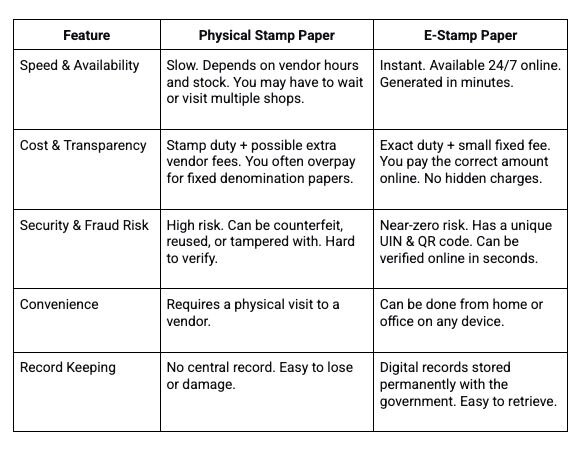
The risks with physical paper are real. It can be forged, backdated, or even a simple clerical error can make it invalid. This puts your partnership agreement in danger.
An e-stamp eliminates these problems. It is a secure digital record locked by the government. It cannot be duplicated or backdated. When you need to verify it - for the MCA, a bank, or in court - you can do it instantly online.
Once again, for your partnership deed (and most other deeds for that matter), the e-stamp is the modern, reliable option.
The physical paper is the old and still very much valid, yet risky way.
Seems like a simple choice to me.
Now, let's look at some common mistakes people make during this process, so you can avoid them completely.
What Are Some Common Errors You Should Avoid with Partnership Deed E-Stamps?
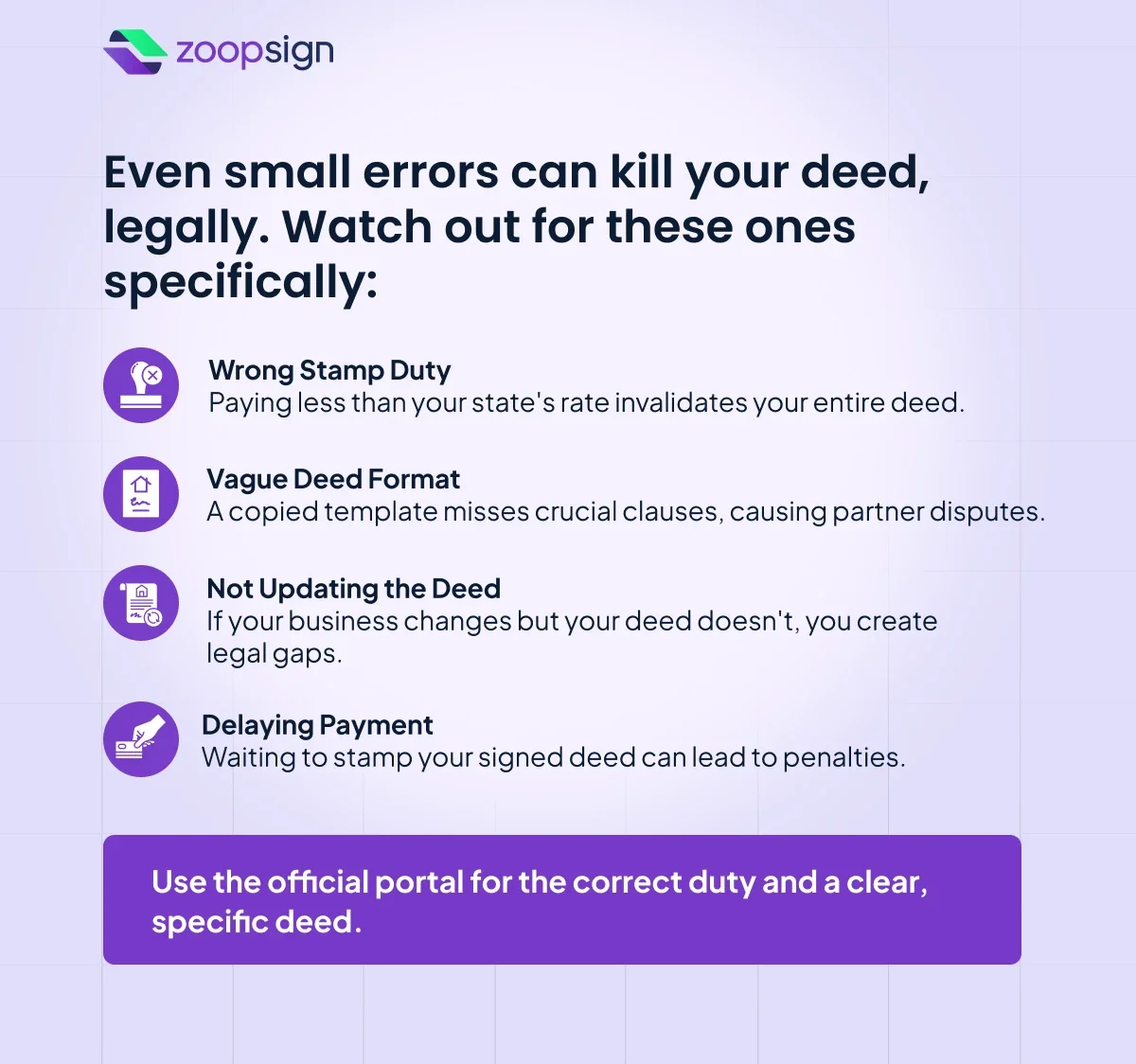
The most common errors are using the wrong stamp duty value, relying on vague deed formats, and forgetting to update your deed as your business grows.
Making these mistakes can weaken your legal protection. A partnership deed is a very sensitive piece of document and so is every other document associated with it. In such cases, even small errors in your partnership deed stamp process can cause big problems later.
Let's walk you through the usual traps so you can avoid them
1. Getting the stamp duty value wrong.
This is the biggest risk. The stamp duty for partnership deed changes by state and is based on your capital. If you pay less than the required amount, your entire deed becomes invalid in court.
Do not guess the amount. Always use the online e-stamping portal or a reliable service that calculates it automatically for your state.
2. Using a generic, vague deed format.
Don't be among those that just copy a template from the internet. These templates often miss very important clauses for your specific business.
]Your deed must clearly state the profit-sharing ratio, how partners can exit, and how to resolve disputes, along with other important details. A vague deed could lead to problems between the partners.
3. Not updating the deed over time.
Your business will change, and so will the people involved. Partners may leave or join, capital may increase, ambitions may differ between partners.
If you do not update your partnership deed and pay the necessary fresh stamp duty for amendments, your old deed will not cover the new situation. This creates legal gaps.
4. Delaying the stamp duty payment.
Once your deed is signed, you should get it stamped quickly. Delays can lead to penalties. With e-stamping, this couldn’t be easier. You can do it immediately after finalizing the details.
Avoiding these errors is simple. Use the online system to get the correct duty, invest in a clear and specific deed format, and remember to update your documents when your business changes.
Frequently Answered Questions:
Q1. What is the stamp duty for a partnership deed e-stamp in 2026?
The stamp duty is not fixed. It depends on which state your firm is in and your total capital amount. It could be a percentage of your capital or a flat fee. The online portal calculates the exact amount for you.
Q2. Which portal should I use for e-stamp partnership deeds online?
You can use the official government portal like shcilestamp.com. For a simpler process, you can also use authorized services like ZoopSign that guide you through each step.
Q3. Is e-stamp valid for partnership deed registration in India?
Yes, absolutely. An e-stamp is fully legal and valid for registering your partnership deed across India. It has the same legal power as a physical stamp paper.
Q4. How many partners can be included in an e-stamp partnership deed?
You can include between 2 to 20 partners in a single partnership deed, and the e-stamp can cover all of them.
Q5. Can I draft a partnership deed before getting the e-stamp?
Yes, you can draft it first. In fact, you need the final details like capital and partner names to buy the e-stamp. Some portals even let you fill a draft directly on their website.
Q6. What is the validity period of an e-stamp partnership deed?
An e-stamp certificate does not expire. It has lifetime validity, just like a correctly purchased physical stamp paper.
Q7. What is the Haryana e-stamp process for a partnership deed?
The process is the same as other states. Go to an official e-stamping website, select Haryana as your state, enter your partnership details and capital, pay the duty (a flat ₹1000 in Haryana), and download your certificate.
Q8. Can I get bulk e-stamps for partnership deed amendments?
Yes, you can purchase multiple e-stamps if you need to amend your deed several times. Each amendment requiring stamp duty will need its own e-stamp certificate.
Q9. What are the differences between e-stamp and franking for partnership deeds?
Both are ways to pay stamp duty. An e-stamp is a digital certificate you get online. Franking is where you take a printed deed to an authorized bank or agent, who physically stamps it with a franking machine. E-stamping is faster and can be done from anywhere.
Q10. Do I need a notary after getting an e-stamp partnership deed?
Notarization is a separate step. The e-stamp proves you paid the duty. You may still need to get the signed deed notarized for bank or registration purposes, but it depends on your specific requirements.