


If you’re renting a house, leasing an office, setting up a new shop, or onboarding tenants at scale, then you must probably know that lease deeds are everywhere.
Yet, they’re often treated casually. Many people assume a lease deed is “just paperwork” or that stamp duty and registration can be figured out later.
That assumption is where problems begin.
A lease deed is a legally binding document. If it’s not stamped correctly or registered when required, it can become difficult sometimes impossible to enforce your rights as a landlord or tenant.
Keep reading to understand the basics of residential lease deeds!
What Is a Lease Deed and Why Does It Matter?
A lease deed is a legal agreement through which the owner of a property (the lessor) grants another person or entity (the lessee) the right to use and enjoy the property for a fixed period, in return for consideration usually rent.
Unlike informal rental arrangements, a lease deed:
- Clearly defines rights and obligations
- Specifies tenure and conditions
- Is legally enforceable when properly stamped and registered
In legal terms, a lease involves a transfer of the right to enjoy property, not ownership.
Lease Deed vs Rent Agreement in India: What’s the Difference?
A rent agreement is typically used for short-term arrangements, usually up to 11 months. A lease deed, on the other hand, is used for longer tenures and more structured arrangements.
This is one of the most searched and misunderstood aspects of property documentation.
While the terms are often used interchangeably, they’re not the same.
Learn more about rent agreement rules to avoid confusion.
Key differences include:
- Tenure: Lease deeds usually exceed 11 months
- Registration: Lease deeds generally require compulsory registration
- Legal strength: Lease deeds offer stronger protection in disputes
- Stamp duty: Calculated differently and often higher for lease deeds
If the arrangement is long-term or commercial in nature, a lease deed is usually the correct document.
What Are the Main Types of Lease Deeds in India?
Lease deeds broadly fall into two categories: residential and commercial. While the legal foundation is similar, the complexity and compliance requirements can differ significantly.
1. Residential Lease Deed
A residential lease deed is used when a property is rented out for living purposes — apartments, independent houses, or residential units.
Common characteristics:
- Shorter or fixed tenures
- Fewer commercial clauses
- Simpler rent and escalation terms
These are common in individual landlord–tenant relationships, but even here, improper stamping or non-registration can create disputes.
2. Commercial Lease Deed
A commercial lease deed applies to properties used for business purposes offices, retail stores, warehouses, factories, or co-working spaces.
Commercial leases are more complex because they often include:
- Longer tenures
- Lock-in periods
- Rent escalation clauses
- Exit and termination conditions
- Maintenance and fit-out responsibilities
Because commercial properties involve higher values and longer commitments, compliance errors here carry higher financial and legal risk.
Is Registration Mandatory for Lease Deeds in India?
Yes, registration is mandatory for certain lease deeds.
Under the Registration Act, 1908, lease deeds must be registered if:
- The lease term exceeds 11 months
- The lease is for a year-to-year period
- The lease involves long-term rights in immovable property
If a lease deed that requires registration is not registered:
- It may not be admissible as evidence in court
- Enforcing rights becomes difficult
- Disputes often favour the other party
Stamp duty alone does not make a lease legally complete registration is what gives it enforceability.
Why Is Stamp Duty Required on Lease Deeds?
Stamp duty is a tax paid to the state government to give legal recognition to a document. A lease deed is considered a chargeable instrument, which means stamp duty is compulsory.
Stamp duty:
- Validates the lease deed
- Makes it legally enforceable
- Is a prerequisite for registration
Skipping or underpaying stamp duty can result in:
- Penalties
- Delays in registration
- Issues during disputes or renewals
How Is Stamp Duty Calculated for Lease Deeds?
Stamp duty on lease deeds is not a flat amount. It depends on multiple factors, which vary by state.
Common factors include:
- Lease tenure
- Monthly rent
- Security deposit (sometimes)
- Lease premium, if any
Residential vs Commercial Stamp Duty
In many states:
- Commercial lease deeds attract higher stamp duty
- Longer lease tenures increase duty liability
- High-value commercial leases face stricter scrutiny
Because stamp duty rules are state-specific, calculating the correct amount is one of the most common pain points in lease transactions.
What Is E-Stamping for Lease Deeds in India?
E-stamping is a digital method of paying stamp duty and generating a government-authorised stamp certificate.
Instead of buying physical stamp paper, parties can:
- Pay stamp duty online
- Generate a tamper-proof e-stamp certificate
- Attach it to the lease deed
E-stamping reduces risks associated with:
- Fake or duplicate stamp papers
- Stamp paper shortages
- Manual errors
Today, e-stamping is widely accepted for both residential and commercial lease deeds across many Indian states. “Check your state-specific process on ZoopSign’s e-stamp guide for Maharashtra, Madhya Pradesh, estamp for Uttar Pradesh, or estamp in Andhra Pradesh.”
How Do You E-Stamp a Lease Deed Step by Step?
While the exact steps may vary slightly by state, the overall process remains similar.
Step 1: Finalise Lease Terms - Agree on rent, tenure, deposit, escalation, and termination clauses.
Step 2: Determine Applicable Stamp Duty - Based on lease tenure, rent, and property type. See ZoopSign’s state-specific e-stamp pages for detailed steps in your state, since the process varies by location.
Step 3: Generate the E-Stamp Certificate - Stamp duty is paid through an authorised e-stamping platform, and a digital certificate is generated.
Step 4: Attach the E-Stamp to the Lease Deed - The certificate becomes part of the executed document.
Step 5: Execute the Lease Deed - Both parties sign the document along with witnesses.
At this stage, the lease is stamped but not yet registered.
How Do You Register a Lease Deed After E-Stamping?
Once e-stamping is complete, the lease deed must be registered (if applicable).
Registration Process Includes:
- Booking an appointment with the Sub-Registrar
- Presenting original documents and identity proofs
- Physical presence of parties or authorised representatives
- Payment of registration charges
Some states offer partial online workflows, but physical verification is usually still required. If you are registering in a specific state, first confirm the local e-stamp and registration workflow on ZoopSign’s state guide for that location.
Delays often occur due to:
- Incorrect stamp duty
- Mismatch in document details
- Missing supporting documents
Common Clauses in Commercial and Residential Lease Deeds
A well-drafted lease deed protects both parties. Some clauses are standard, while others are more common in commercial leases.
Key clauses include:
- Lease term and renewal
- Rent and escalation
- Security deposit
- Maintenance and utilities
- Lock-in period (commercial)
- Termination and exit conditions
Commercial lease deeds typically include more detailed clauses to address business risks.
What Are the Most Common Mistakes in Lease Deed Stamping and Registration?
Despite clear rules, mistakes are common and costly.
Some frequent errors include:
- Paying incorrect stamp duty
- Assuming registration is optional
- Treating commercial leases like residential ones
- Ignoring state-specific rules, which is why you should check your state’s e-stamp process on ZoopSign before drafting or executing the deed.
- Delaying stamping until disputes arise
Many of these issues surface only when:
- A dispute occurs
- The lease is renewed
- The property is sold or mortgaged
Fixing them later is often far more expensive than doing it right the first time.
Why Digital Workflows Matter for Lease Deeds
Lease deeds aren’t always one-off transactions.
Banks, NBFCs, real estate developers, co-working operators, and large landlords deal with:
- High volumes of lease documents
- Multiple cities and states
- Repeated stamp duty payments
- Compliance tracking challenges
In such cases, manual stamping processes quickly become inefficient and error-prone.
For teams operating across multiple states, ZoopSign’s state-wise e-stamp resources help standardize compliance across locations.
How Does ZoopSign Simplify Lease Deed E-Stamping?
ZoopSign supports lease deed execution through customised e-stamp workflows built around real-world use cases.
Instead of treating e-stamping as a standalone task, ZoopSign enables:
- On-the-fly e-stamp generation for individual leases
- Pre-procured e-stamp inventories for high-volume use
- State-specific compliance handling
- Seamless integration into leasing, lending, and onboarding journeys
This approach is especially useful for organisations managing leases across locations and asset types.
What Is the Difference Between Residential and Commercial Lease Deeds?
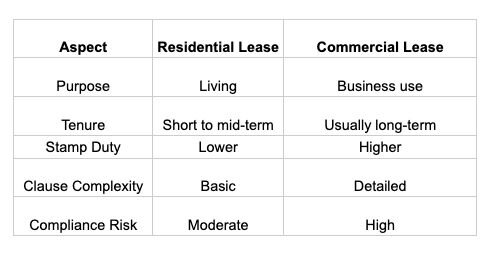
What Should You Do to Get Lease Deeds Right From Day One?
Lease deeds may seem routine, but legally, they’re anything but simple. E-stamp early, register promptly, use tools like ZoopSign. Save costs on disputes.
From stamp duty calculation to e-stamping and registration, each step plays a role in protecting rights and preventing disputes. With increasing digitization, e-stamping has become the backbone of compliant lease execution, especially for commercial and large-scale residential use cases.
Whether you’re an individual landlord, a tenant, or an organisation managing leases at scale, getting the process right from day one saves time, money, and legal headaches later.
Frequently Asked Questions:
Q1. What is the difference between a lease deed and a rent agreement?
A: A rent agreement is generally used for short-term arrangements, usually up to 11 months, while a lease deed is used for longer tenures. Lease deeds typically require compulsory registration and offer stronger legal enforceability compared to rent agreements.
Q2. Is stamp duty mandatory for lease deeds?
A: Yes, stamp duty is mandatory for lease deeds. A lease deed is a chargeable instrument under stamp laws, and paying stamp duty is necessary to make the document legally valid and enforceable.
Q3. How is stamp duty calculated on a lease deed?
A: Stamp duty on a lease deed is usually calculated based on factors such as lease tenure, monthly rent, security deposit, and any lease premium involved.
Q4. Can lease deeds be e-stamped?
A: Yes, lease deeds can be e-stamped in states where e-stamping is enabled. E-stamping allows stamp duty to be paid digitally and generates a secure e-stamp certificate that replaces traditional physical stamp paper.
Q5. Is registration compulsory for lease deeds?
A: Registration is compulsory for lease deeds where the lease term exceeds 11 months or creates long-term rights in immovable property. If such a lease deed is not registered, it may not be legally enforceable in case of disputes.