


When people think of property transfer, the first thing that usually comes to mind is a sale where one party sells, the other pays, ownership changes hands. But not all property transactions involve money changing hands.
In many real-world situations, especially in real estate development, family settlements, or strategic asset planning, properties are exchanged instead of sold.
This is where a Deed of Exchange comes into play.
Despite being legally recognised and fairly common, deed of exchange transactions are often misunderstood. Questions around stamp duty, taxation, registration, and documentation frequently create confusion, leading to delays or compliance risks later.
Keep reading to know more about a Deed of Exchange in property transfer!
What Is a Deed of Exchange in Property Transfer?
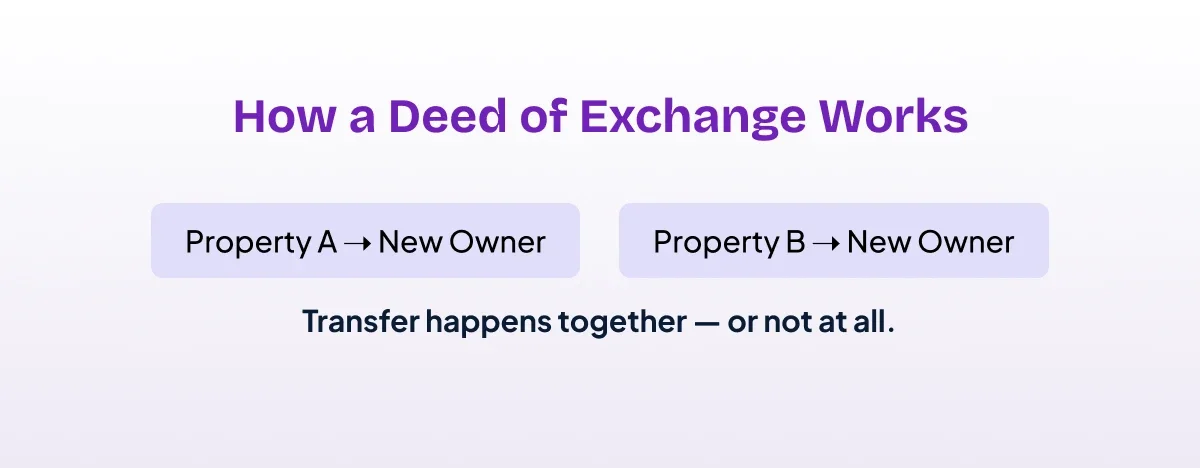
A Deed of Exchange is a legal document through which two parties mutually transfer ownership of one property in exchange for another property.
Instead of monetary consideration, the consideration in this transaction is another immovable asset.
In simple terms:
- Party A gives Property X
- Party B gives Property Y
- Both transfers happen simultaneously under one legally executed deed
The exchange can be between:
- Two individuals
- An individual and a developer
- Family members
- Business entities
It is important to understand that even though money may not be involved, a deed of exchange is still treated as a transfer of property under Indian law and must comply with all legal and taxation requirements.
How Does a Deed of Exchange Differ from Sale or Gift Deeds?
One of the biggest sources of confusion is assuming that a deed of exchange is similar to a gift deed or a sale deed. While all three result in ownership transfer, they differ significantly.
- Sale Deed: Transfer happens against monetary consideration
- Gift Deed: Transfer happens voluntarily without consideration
- Deed of Exchange: Transfer happens against non-monetary consideration (another property)
This distinction becomes especially important when it comes to stamp duty and income tax, because exchange deeds are not exempt simply because cash is not involved.
When Is a Deed of Exchange Commonly Used in India?
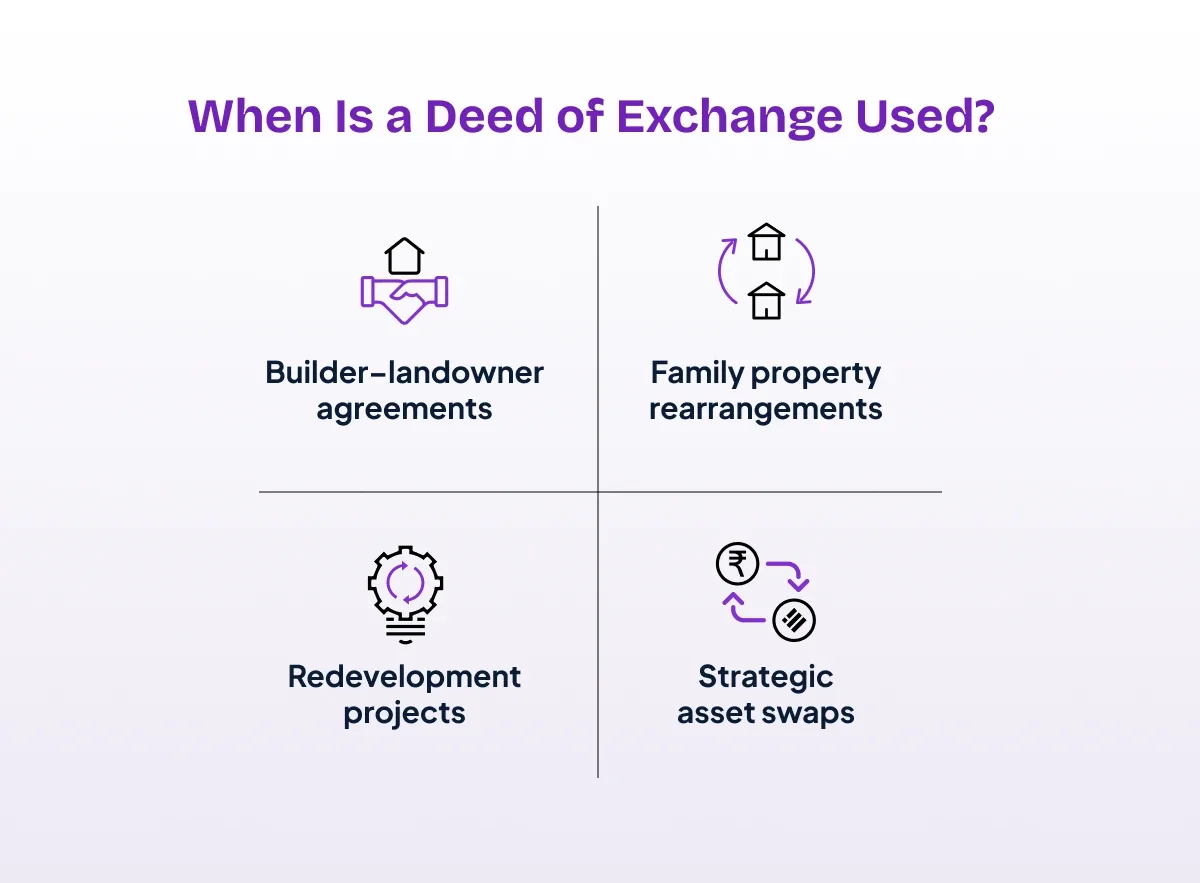
Deeds of exchange are widely used in scenarios where swapping assets makes more sense than selling and repurchasing.
1. Builder-Landowner Arrangements
In real estate development, landowners often exchange land for constructed units. Instead of selling land outright, the landowner receives flats, commercial units, or developed plots in return.
2. Family Property Rearrangement
Families sometimes exchange properties between members to consolidate assets, settle inheritance issues, or distribute property more efficiently.
3. Strategic Asset Planning
Businesses and investors may exchange properties to align assets with operational needs, locations, or future growth plans.
4. Urban Redevelopment Projects
Local redevelopment or rehabilitation projects may involve exchange of old properties for new ones of equivalent or higher value.
In all these cases, a properly drafted and stamped deed of exchange is essential.
Is a Deed of Exchange Legally Valid in India?
Yes. A deed of exchange is fully recognised under Indian law.
The legal basis comes from Section 118 of the Transfer of Property Act, 1882, which defines exchange as a transfer of ownership of one property for another.
For a deed of exchange to be legally valid, the following conditions must be met:
- Both parties must have clear ownership titles
- The exchange must be based on mutual consent
- Proper stamp duty must be paid
- The deed must be executed and registered
- Property descriptions must be accurate and complete
Failure to meet any of these conditions can render the transaction legally weak or unenforceable.
What Essential Components Must a Deed of Exchange Include?
A deed of exchange is more than just a declaration that two properties are being swapped. It is a detailed legal instrument that must clearly record the rights, obligations, and intent of both parties.
1. Details of the Parties: Full names, addresses, identification details, and legal capacity of both parties involved in the exchange.
2. Description of Both Properties: Each property must be described in detail, including:
- Location
- Survey numbers
- Boundaries
- Area and measurements
- Nature of ownership
Any ambiguity here can lead to registration issues or future disputes.
3. Declaration of Ownership: Both parties must explicitly declare that they are the lawful owners of the respective properties and have the right to transfer them.
4. Exchange Clause: This is the core clause that clearly states:
- Which property is being exchanged for which
- That the exchange is mutual and voluntary
- Whether the exchange is absolute or conditional
5. Possession Clause: Defines when and how possession of the exchanged properties will be handed over.
6. Indemnity Clause: Protects both parties against future claims, defects in title, or third-party disputes related to the exchanged properties.
7. Dispute Resolution Clause: Specifies how disputes will be handled through courts, arbitration, or other mechanisms.
8. Execution and Witnesses: The deed must be signed by both parties and attested by witnesses as per legal requirements.
Stamp Duty on Deed of Exchange in India
One of the most critical aspects of a deed of exchange is stamp duty.
A common misconception is that stamp duty is lower or optional because no money is involved. In reality, stamp duty is mandatory.
How Is Stamp Duty Calculated on a Deed of Exchange?
In most Indian states:
Stamp duty is calculated on the higher market value of the two properties being exchanged.
For example: This means if Property A is worth ₹50 lakh and Property B is worth ₹70 lakh, stamp duty will typically be charged on ₹70 lakh.
What Are State-Wise Variations in Stamp Duty for Exchanges?
Stamp duty rates and rules vary from state to state. Some states charge duty on:
- The higher value property
- The difference in value
- Or both properties in certain cases
Because of these variations, understanding the state-specific e-stamping process becomes crucial.
What Are Registration Charges and Process for Deed of Exchange?
In addition to stamp duty, registration charges must be paid to the Sub-Registrar of Assurances.
These charges are usually:
- A percentage of the property value
- Subject to minimum and maximum caps depending on the state
Stamp duty payment alone does not complete the transaction — registration is what gives the deed legal enforceability.
How Is Taxation Handled on Deed of Exchange in India?
From a tax perspective, a deed of exchange is treated as a transfer under the Income Tax Act, 1961.
Capital Gains Tax
Each party involved in the exchange may be liable to pay capital gains tax on the property they transfer.
Here are the Key points:
- The fair market value of the property received is treated as the sale consideration
- Capital gains are calculated based on holding period and indexed cost (where applicable)
- Long-term and short-term capital gains rules apply just like a sale
Why Capital Gains Tax Matters
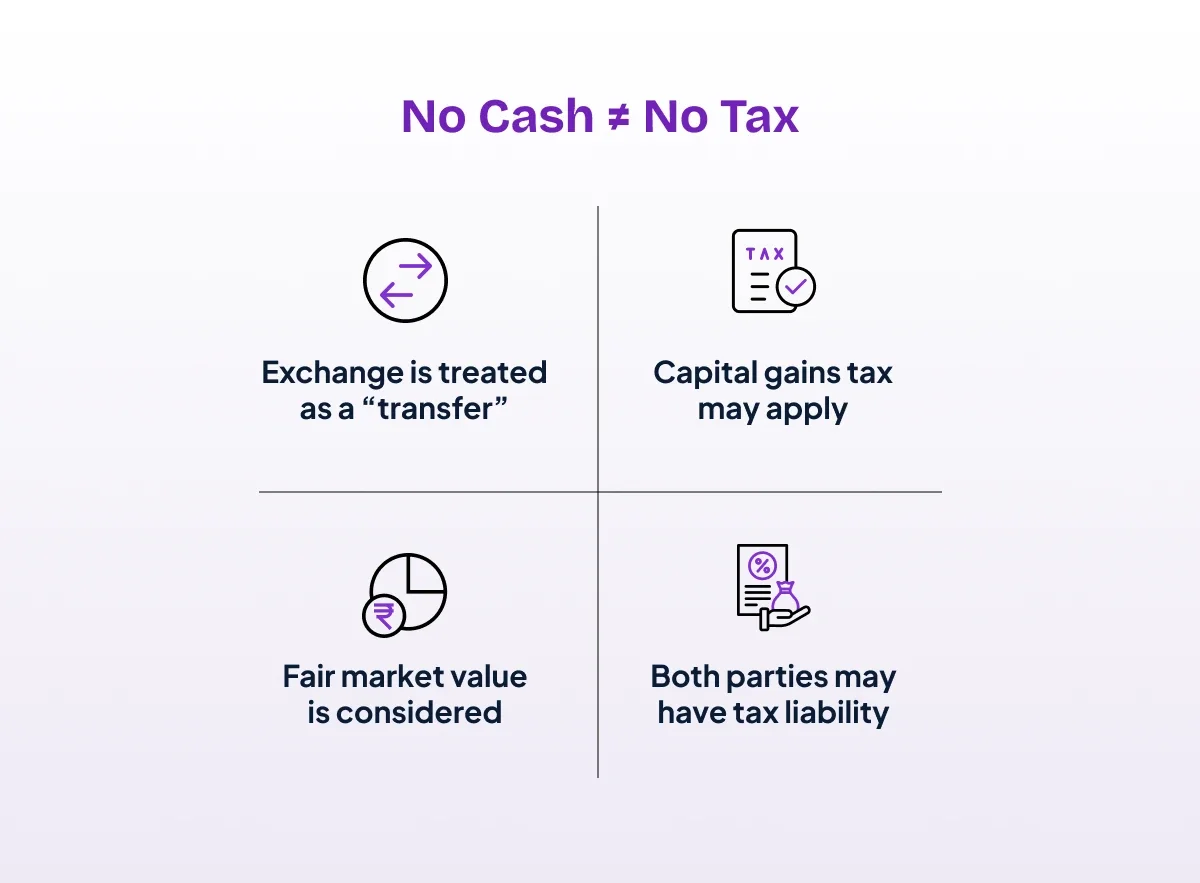
Many people assume that because no cash is received, no tax is payable. This assumption can lead to compliance issues and penalties later.
It is always advisable to consult a tax professional before executing an exchange deed.
Stepwise Guide: How to Register a Deed of Exchange?
The process of executing and registering a deed of exchange generally involves the following steps:
- Drafting the deed with accurate property and party details
- Determining market value of both properties
- Calculating applicable stamp duty and registration charges
- Paying stamp duty through authorised channels
- Executing the deed by both parties
- Registering the deed at the Sub-Registrar office
Delays often occur at the stamp duty payment stage, especially when high-value properties or multiple parties are involved.
What Role Does E-Stamping Play in Deed of Exchange Transactions?
E-stamping has become the preferred mode of stamp duty payment for property transactions across many Indian states.
Instead of purchasing physical stamp paper, e-stamping allows parties to:
- Pay stamp duty digitally
- Generate a tamper-proof e-stamp certificate
- Reduce risks of fraud or shortages
In deed of exchange transactions, e-stamping is particularly useful because:
- Stamp duty amounts are often high
- Valuation accuracy is critical
- Transactions may involve developers, lenders, or multiple stakeholders
This is where having a reliable, workflow-based e-stamp solution becomes important.
How Can Digital Tools Like ZoopSign Simplify E-Stamping?
Property transactions rarely follow a one-size-fits-all process. Exchange deeds especially require flexibility different parties, different state rules, different documentation flows.
ZoopSign supports e-stamping through customised workflows designed to fit real-world property and lending journeys.
Depending on the use case, ZoopSign enables:
- On-the-fly estamp generation for time-sensitive transactions
- Pre-procured e-stamp inventory for large-scale or repeat use cases
- Seamless integration into real estate, lending, and onboarding workflows
- Compliance with state-specific stamping requirements
Rather than treating estamping as a standalone step, ZoopSign helps embed it naturally into the overall documentation journey.
Deed of Exchange vs Sale Deed: Key Tax and Stamp Duty Differences

A deed of exchange is a powerful tool in property transfer but only when executed correctly.
From accurate drafting and valuation to stamp duty payment, taxation, and registration, every step matters. With increasing digitisation, estamping has become central to ensuring speed, transparency, and compliance in these transactions.
Whether you are a landowner, developer, lender, or legal professional, understanding how exchange deeds work and how digital infrastructure supports them, can help avoid costly delays and compliance risks later.