


Buying a property in Chennai is a big deal and honestly, it should feel that way.
If it’s a residential flat in Anna Nagar, a plot along Old Mahabalipuram Road (OMR), or a commercial space in T. Nagar, It is a major financial commitment that needs careful attention to detail at every step.
After identifying and finalizing a property, one of the key legal requirements before ownership can be transferred is the payment of stamp duty and registration charges.
These are mandatory charges applicable to all property transactions in Tamil Nadu.
What is stamp duty in Chennai?
Stamp duty is a tax that you pay to the state government when you buy or transfer a property. Think of it as the government's way of officially recognising that a property transfer has taken place.
When you pay stamp duty, you're actually getting your property transaction legally "stamped" and acknowledged by the authorities.
In Chennai and across Tamil Nadu stamp duty is collected under the Indian Stamp Act, 1899 and the Tamil Nadu Stamp Act. The amount you pay is usually calculated as a percentage of the property's market value or the transaction value, whichever is higher.
So if you're buying a flat worth ₹80 lakhs, the stamp duty will be calculated on that value.
It's not a flat fee, it scales with the size of your purchase.
Why is stamp duty so important for property buyers in Chennai?
You might be thinking "Can't I just skip this and save some money?"
Absolutely not.
Here's why stamp duty in Chennai is not just a formality, but a genuinely important step:
1. Stamp duty provides Legal Proof of Ownership:
Once you pay stamp duty in Chennai and register your property, you get a registered sale deed, the only document that legally proves the property is yours.
Without it, your claim holds no weight in court, it doesn't matter how much you've paid.
2. Stamp duty Protects You from Property Fraud:
Paying stamp duty in Chennai gets your transaction recorded permanently at the Sub-Registrar's Office.
This public record makes it nearly impossible for anyone to sell the same property twice or question your ownership.
3. Stamp duty is Mandatory Under Indian Property Laws:
Under the Registration Act, 1908, paying stamp duty in Chennai is compulsory before registering any property.
Skip it, and your sale deed becomes legally invalid, banks won't approve loans on it, and future resale becomes a nightmare.
When is stamp duty paid during property registration?
During Property Registration Stamp duty in Chennai is paid on the day you visit the Sub-Registrar's Office to register your property.
Both buyer and seller must be present, and the payment is made before the documents are officially processed.
And before execution of the sale deed stamp duty in Chennai must be paid before or at the time of signing the sale deed never after.
In Tamil Nadu, this is done easily through e-GRAS or e-stamping. An unstamped sale deed is legally invalid, so there's simply no skipping this step.
What are registration charges in Chennai?
In easy terms, registration charges are the fees collected by the Tamil Nadu government for registering your property documents at the Sub-Registrar's Office.
In Chennai, registration charges are usually 1% of the property's market value, subject to a maximum cap.
So on a ₹80 lakh property, you'd be paying around ₹80,000 as registration charges on top of your stamp duty.
Together, stamp duty and registration make your property purchase 100% legal, official, and protected under the law.
What is the difference between stamp duty and registration charges?
This is one of the most confusing points for first-time property buyers.
People often assume that stamp duty and registration charges are actually the same thing but they're two separate payments with different purposes.
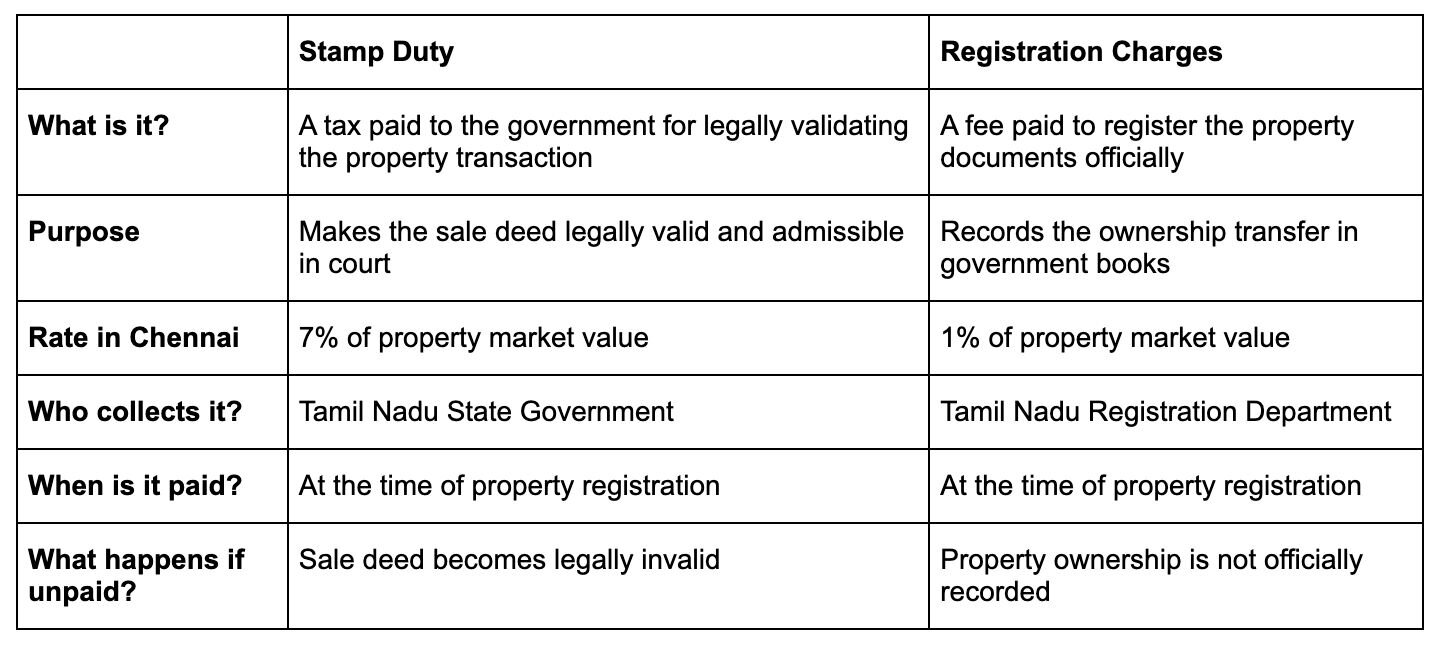
Well the easiest way to remember the difference is that stamp duty makes your transaction legal, while registration charges make your ownership official.
Both are paid together on the day of registration, but they have different purposes.
For example, on a property worth ₹60 lakhs in Chennai:
- Stamp Duty (7%) = ₹4,20,000
- Registration Charges (1%) = ₹60,000
- Total Cost = ₹4,80,000
What are the latest stamp duty & registration charges in Chennai (2026)?
If you're planning to buy a property in Chennai this year, the first thing you need to get clear on is how much you'll actually be paying in stamp duty and registration charges on top of the property price itself.
These charges can add up to a certain amount, so knowing the current rates upfront will help you plan your budget smartly.
As of 2026, buyers in Chennai pay 7% of the property value as stamp duty and an additional 1% as registration charges bringing the total outgo to 8% of the property's market value.
What are stamp duty charges for different transaction types in Chennai?
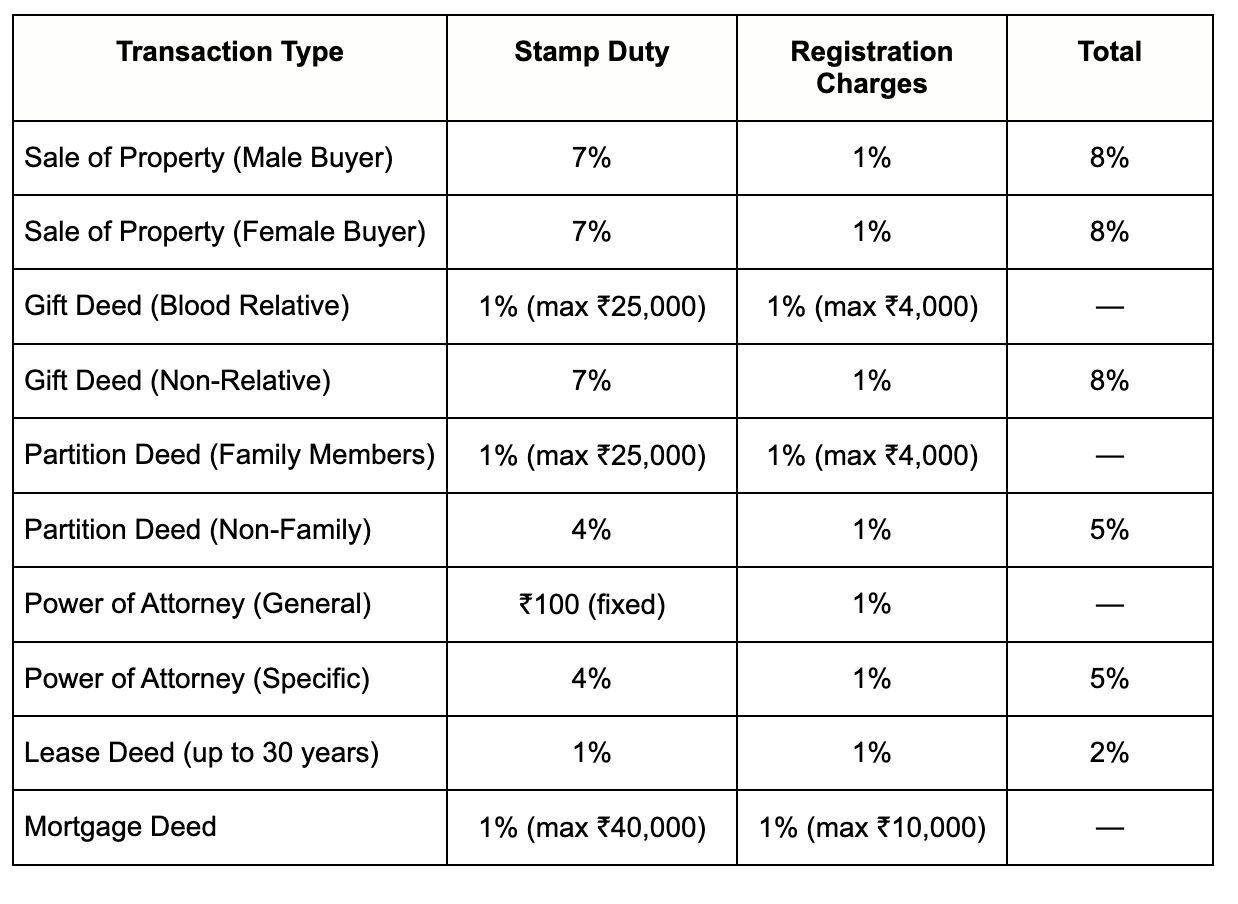
Note: All percentages are calculated on the higher of the property's market value or the government's guideline value.
*Tamil Nadu currently does not offer any stamp duty concession for female buyers on regular sale deeds; both male and female buyers pay the same rate.
What are stamp duty charges for different property documents in Chennai?
Typically, when most people think about stamp duty charges on property, they assume it's one flat rate for everything.
But that's not quite how it works.
In Chennai, different types of property documents have different stamp duty charges and knowing exactly which rate applies to your deal can save you from a bad surprise when you finally show up at the Sub-Registrar's Office.
For example, smaller legal documents like affidavits or general authorisations are usually executed on a 100 rupees stamp paper, whereas property sale deeds require percentage-based stamp duty based on the property value.
Stamp Duty Charges on Property Documents in Chennai (2026)
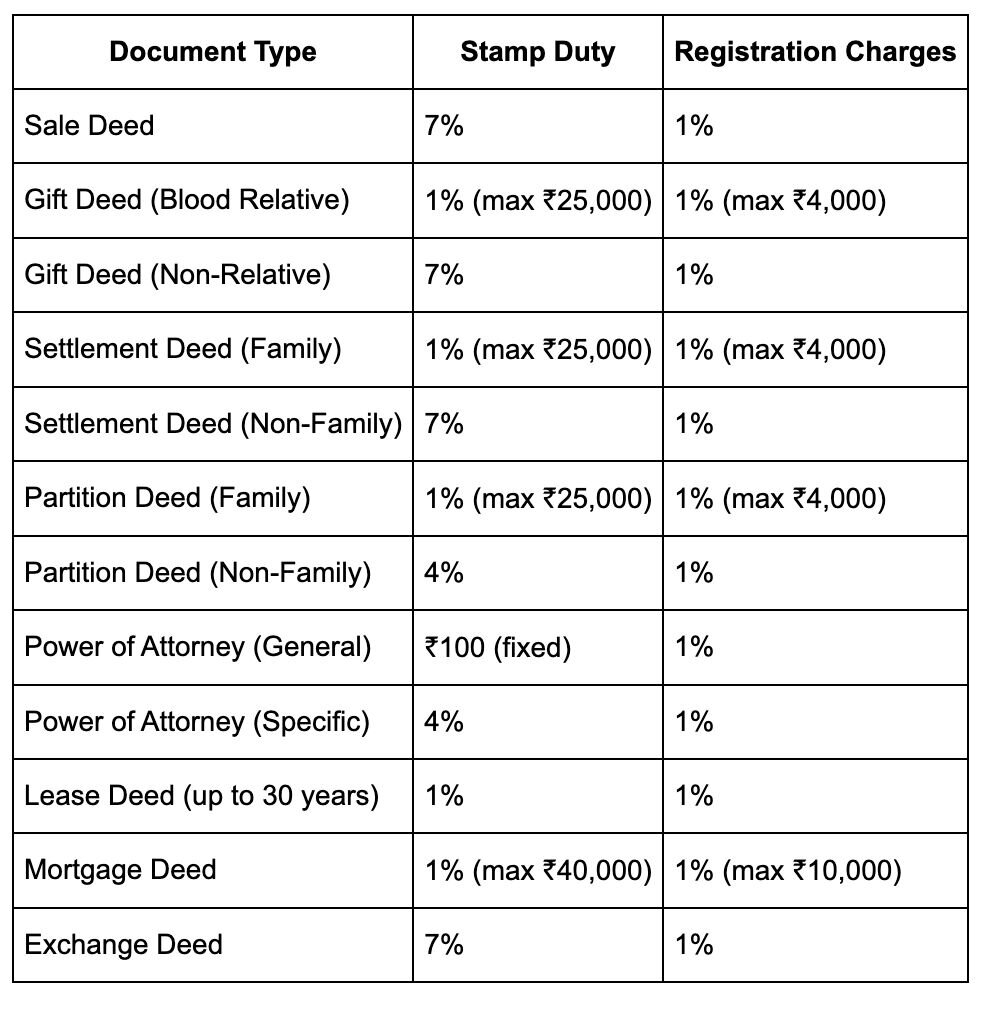
Note: All rates are calculated on the higher of the actual transaction value or the government's guideline value for that area.
What stamp duty concessions are available in Chennai?
Now here's something that not every buyer in Chennai is aware of, you may actually be eligible for a reduction in stamp duty charges, depending on who you are and what kind of transaction you're making.
The Tamil Nadu government has put in place several concessions to make property ownership more affordable, especially for women, families, and buyers under government housing schemes.
Is there a concession for women property buyers in Chennai?
If you're a woman buying property in Chennai, there's a helpful concession you should know about.
The stamp duty rate stays at 7% regardless of gender but where it gets interesting is the registration fee.
The Tamil Nadu government offers a reduced registration charge for properties registered in a woman's name.
If the property is valued up to ₹10 lakhs, this concession can make a difference to your overall costs, something worth considering if you're looking at affordable housing or plots on the outskirts of Chennai.
And the benefits don't stop there. When a property is jointly registered with a woman as the first owner, many banks and financial institutions also offer a reduction in home loan interest rates.
So beyond the registration savings, you could end up paying less on your EMIs too. Great deal right?
What concessions apply to family property transfers?
Transferring property within the family? Well you are in luck
Chennai offers a little lower stamp duty charges on property when it stays within the family.
1. Gift Deeds Among Family Members
Stamp duty drops to just 1% of the property value, and registration charges follow suit at 1% (capped at ₹4,000).
So even on a ₹1 crore property, your total outgo is just ₹29,000, compared to the regular 8%. That's a good saving worth planning around.
2. Settlement Deeds
A settlement deed is how property owners legally distribute assets among their heirs usually to avoid conflicts later.
The good news is that the rates are identical to gift deeds: 1% stamp duty (capped at ₹25,000) and 1% registration charges (capped at ₹4,000).
It's one of the most tax-efficient ways to pass on property to your children while you're still alive.
3. Government Housing Scheme Benefits
Buying under PMAY or a Tamil Nadu affordable housing scheme? You could be eligible for reduced or in some cases, fully waived stamp duty charges, particularly if you fall under the EWS or LIG categories.
Since these concessions are updated once in a while, you have to keep checking the latest details with the Tamil Nadu Registration Department or your scheme coordinator before you go ahead.
How to Calculate Stamp Duty & Registration Charges
Before you finalise your purchase, it actually helps to know exactly what you'll be paying in stamp duty and registration charges, so no surprises on registration day.
The calculation is simpler than most people expect. No special calculator needed, just a basic formula and your property value.
The Formula
- Stamp Duty = Property Value × Stamp Duty Rate
- Registration Charges = Property Value × Registration Rate
One thing to keep in mind is that the "property value" used here is always the higher of either what you're actually paying the seller, or the government's guideline value for that area.
So even if you've negotiated a great deal, stamp duty is calculated on whichever number is higher.
For Example
Say you're buying a residential apartment in Chennai for ₹85 lakhs, and the guideline value for that area is ₹80 lakhs.
Since your transaction value is higher, the calculation is based on ₹85 lakhs.
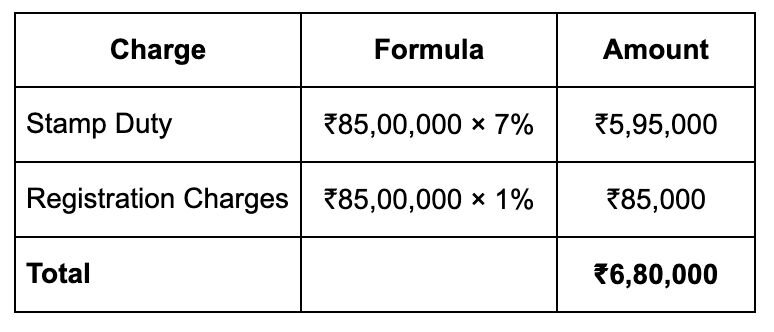
So on top of your ₹85 lakh property, you'll need an additional ₹6,80,000 ready on registration day.
This amount goes directly to the government and is almost never covered by your home loan, so make sure that you've planned for it beforehand.
What factors affect stamp duty in Chennai?
If you have ever questioned why two properties with the same price tag end up with different stamp duty amounts? It usually comes down to three things.
How does property location affect stamp duty?
Location plays a really big role than most people realise.
Properties within Chennai's city limits or under CMDA jurisdiction follow normal stamp duty rates, while those in suburban or panchayat areas on the outskirts may be calculated differently.
So before you sign anything, make sure to check which local authority your property comes under.
How does property type affect stamp duty calculation?
Different property types are treated differently:
- Apartments: Stamp duty is calculated on the total sale value, which has both the land portion (UDS) and construction cost.
- Plots: Only the land value is considered, which keeps the calculation fairly straightforward.
- Commercial Spaces: The rates are the same as residential, but since commercial properties tend to have higher valuations, the final stamp duty amount usually ends up being higher.
What is the difference between guideline value and market value?
The Tamil Nadu government assigns a guideline value to every property, think of it as the minimum price at which a property can be registered.
And the market value is simply what you and the seller agree to pay.
So stamp duty is always calculated on whichever of the two is higher. This keeps property transactions more clear and prevents underreporting of values.
What is the property registration process in Chennai?
Registering your property in Chennai is more simple than it sounds, you just need to know what's coming.
Step 1: Check Your Property's Guideline Value
Head over to tnreginet.gov.in and look up the guideline value for your property.
This is the government's minimum registered price for that area, and your stamp duty and registration charges will be calculated on whichever is higher, the guideline value or what you're actually paying the seller.
Step 2: Pay Your Stamp Duty
Once you know the value, pay your stamp duty through e-Stamping via SHCIL or any authorised bank.
In Chennai, that's currently 7% of the property value, plus a 1% registration charge. And just keep your stamp certificate safe, you'll need it for the next steps.
Step 3: Get Your Documents in Order
After that, have your sale deed drafted by a licensed document writer or lawyer, and double-check that all the details are accurate.
Along with the deed, make sure you have these ready:
- Title deed and parent documents
- Encumbrance Certificate (EC)
- PAN card and Aadhaar of both buyer and seller
- Passport-size photographs
Step 4: Book Your Appointment
Book a slot at the Sub-Registrar Office (SRO) through the Tamil Nadu Registration Department's portal.
Make sure you pick the SRO that has jurisdiction over your property's location, even though walk-ins are allowed, but booking online will save you a lot of waiting time.
Step 5: Show Up for Biometric Verification
On the day of your appointment, the buyer, seller, and two witnesses all need to be present at the SRO.
Everyone's fingerprints and photographs are taken and this is a standard step to verify identities and prevent fraud registrations.
Step 6: Get It Officially Registered
Finally, the Sub-Registrar reviews your documents, collects the registration fee, and registers the property in your name.
You'll walk out with an acknowledgement receipt the same day, and your fully registered document will usually be ready to collect within 1 to 3 working days.
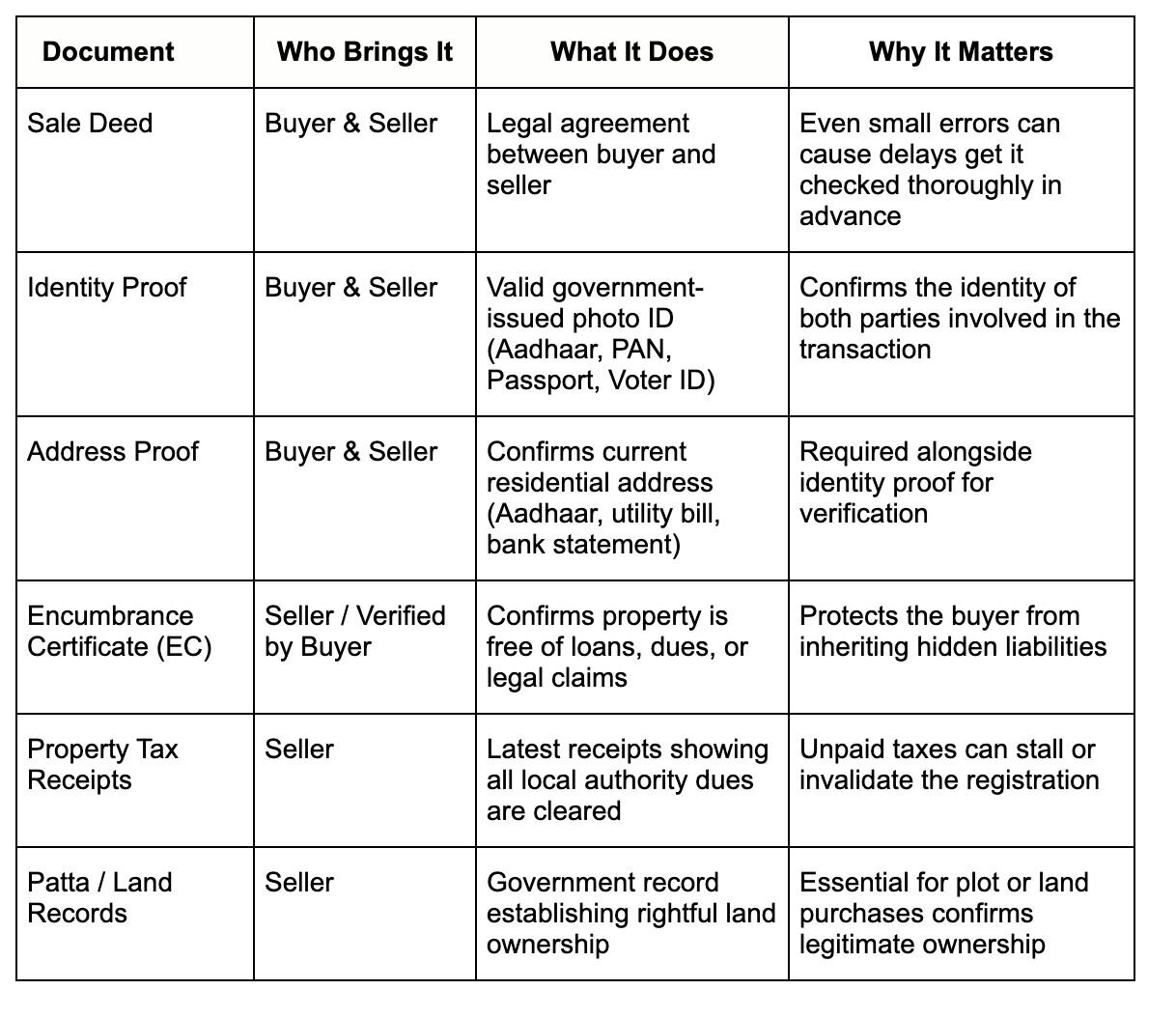
What documents are required for property registration in Chennai?
When it comes to documents, the last thing you want at your Sub-Registrar appointment is to realize you're missing a document.
What are additional costs when buying property in Chennai?
When budgeting for your property purchase, keep in mind that the price tag on the property is just the starting point.
On top of that, you'll need to set aside 7% of the property value for Stamp Duty and another 4% for the Registration Fee, together, that's already 11% added to your total cost.
Then there are the smaller but still important charges.
Document Writing typically runs anywhere between ₹1,000 and ₹5,000, and if you're working with a lawyer or advocate, their fee will vary depending on the value of your deal. Finally, pulling an Encumbrance Certificate will cost you around ₹200 to ₹500.
How to pay stamp duty in Chennai?
Now paying stamp duty in Chennai is much simpler today than it used to be.
You don’t have to deal with long queues or complicated paperwork unless you want to. You can either pay it online from home or visit a bank or office in person, whichever feels more convenient.
Here’s how both options work:
Online Payment
For most people, paying online is the easiest option. You can do it through the Tamil Nadu Registration Department’s portal.
- Visit the official website (tnreginet.gov.in) and log in (or create an account if you’re new)
- Go to the e-Stamping section
- Enter your property details and the stamp duty amount
- Make the payment using net banking, UPI, or your debit/credit card
- Once done, download and save your e-Stamp certificate
The biggest advantage here is convenience. It’s quick, paperless, and you can finish everything well before your Sub-Registrar appointment, so there’s one less thing to worry about on the day.
Offline Payment
If you’re more comfortable handling things in person, that’s completely fine too. There are two simple ways to do it:
1. Authorised Banks
Many nationalised and private banks in Chennai are authorised to collect stamp duty. You can visit a nearby branch, fill out a form, make the payment, and collect your stamped certificate right there.
2. Sub-Registrar Offices
You can also pay directly at your Sub-Registrar Office when you go for registration. That said, this can sometimes slow things down, especially if there’s a queue, so paying in advance is usually the better option.
Tip: No matter which method you choose, make sure you keep your stamp certificate safe, since replacing it later can be difficult and time-consuming.
What are common mistakes to avoid during property registration in Chennai?
Even small mistakes during property registration can create stress, delays, or even legal issues later on.
So here are some common pitfalls people run into, and how you can avoid them:
1. Undervaluing the property
It might be tempting to declare a lower property value to save on stamp duty, but this can actually backfire.
It’s considered illegal and can lead to penalties, fines, or even cancellation of the registration. It’s always better to be accurate and stay on the right side of the law.
2. Ignoring the guideline value
In Chennai, stamp duty is calculated based on whichever is higher, the market value or the government’s guideline value.
If you don’t check this beforehand, you might end up surprised by higher costs on the day of registration.
3. Missing documents
This is more common than you’d think. If even one important document is missing, your Sub-Registrar appointment could get delayed or cancelled.
It’s always a good idea to double-check everything the day before sale deed, ID proof, tax receipts, and all supporting papers.
4. Not verifying the Encumbrance Certificate
The Encumbrance Certificate shows if the property has any existing loans, legal disputes, or unpaid dues.
If you don’t verify it, you could unknowingly take on someone else’s liabilities, so make sure to always check this before you go ahead with the purchase.
Conclusion
Stamp duty and property registration in Chennai can seem a bit hard and confusing at first, but it really doesn’t have to be.
Once you get a clear idea of how the charges are calculated, what documents you’ll need, and the steps, everything starts to feel much easier.
And obviously a little preparation goes a long way here. If you check the guideline value in advance, keep all your documents ready, and look into legal ways to reduce costs, you’ll avoid most last-minute shocks.
In the end, it’s all about being prepared. So make sure to research well and prepare everything in advance.
Frequently Asked Questions
Q: What Is the Current Stamp Duty Rate in Chennai?
Stamp duty in Chennai is 7% of the property value, with an additional registration fee of 4%. Together, this amounts to 11% of the property's value or guideline value whichever is higher.
Q: Can Stamp Duty be Paid Online in Chennai?
Yes. You can pay stamp duty online through the Tamil Nadu Registration Department's portal at tnreginet.gov.in using net banking, UPI, or a debit/credit card.
Q: Is Stamp Duty the Same for All Property Types?
The rate is the same, but the amount varies based on the property type and its valuation. Commercial properties usually result in higher stamp duty due to their higher valuations.
Q: Can Stamp Duty be Reduced for Women Buyers?
Yes. Tamil Nadu offers a stamp duty concession for properties registered in a woman's name or jointly with a woman co-owner.
Q: What Happens If I Undervalue My Property During Registration?
Undervaluing a property to reduce stamp duty is illegal and can attract penalties, fines, and in serious cases, cancellation of the registration.
Q: How Long Does Property Registration Take in Chennai?
With an online appointment and all documents in place, registration can be completed in a single visit. The registered document is typically ready for collection within 1–3 working days.